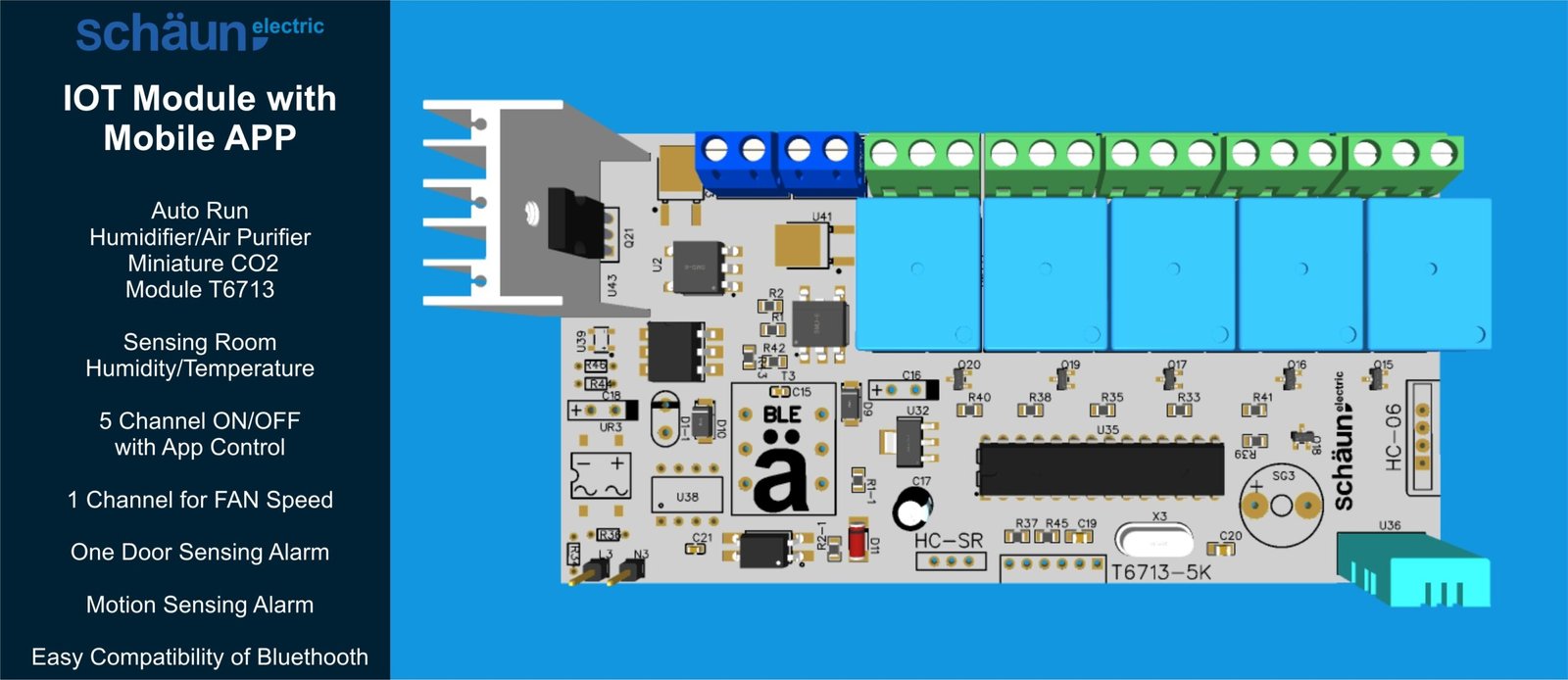


Smart Home Automation with Miniature CO₂ Module T6713 and BLE Multi-Device Control
Introduction
Modern smart homes are no longer just about convenience; they are about health, energy efficiency, and automation intelligence. Among the many parameters that define a healthy indoor environment, carbon dioxide (CO₂) levels play a vital role. Your body naturally wants to expel CO₂, which means you should avoid high concentrations of it in the air you breathe.
The Amphenol Advanced Sensors Telaire T6713 is a miniature, energy-efficient CO₂ sensor module designed for precision indoor air quality monitoring. When integrated with a Bluetooth Low Energy (BLE) automation system, it becomes the brain of a fully automated environment — controlling ventilation, lighting, and appliances based on air quality, occupancy, and user preferences.
Core of the System: Telaire T6713 Miniature CO₂ Module
The T6713 module is a factory-calibrated NDIR (Non-Dispersive Infrared) CO₂ sensor that measures concentrations up to 5000 parts per million (ppm) with high accuracy.
Key Features:
-
Size: 30 mm × 15.6 mm × 8.6 mm — perfect for embedding in compact control units.
-
Low Power: Ideal for energy-conscious designs and battery-powered BLE hubs.
-
Interfaces: I²C, UART, or PWM for flexible microcontroller communication.
-
ABC Logic™: Patented self-calibration that eliminates the need for frequent recalibration in most environments.
-
Accuracy: Maintains stability and reliability throughout its lifetime.
Complete Smart Home BLE Automation Solution
System Overview
Each room in the home is equipped with:
-
BLE Device Controller (ESP32 or similar microcontroller)
-
Telaire T6713 CO₂ Sensor for air quality monitoring
-
5-Device Relay Control Module (LED lights, light load devices, heavy load devices, appliance control)
-
Fan with PWM Speed Control
-
Two Motion Sensors:
-
Door Sensor: Detects entry/exit.
-
Human Presence Sensor: Detects ongoing occupancy to avoid false triggers.
-
-
AI Automation Engine: Processes sensor data and sends control commands automatically.
How It Works
-
Room-by-Room BLE Control
-
Every room is an independent BLE node.
-
The user can connect to the room’s BLE controller via a smartphone or central hub.
-
BLE ensures low latency and secure, localized control without relying on internet connectivity.
-
-
CO₂ Monitoring and AI-Driven Control
-
The T6713 CO₂ Module continuously measures CO₂ concentration.
-
If CO₂ levels exceed 1000 ppm (indicating poor air quality), the AI system:
-
Increases fan speed via PWM output.
-
Activates ventilation or opens automated vents.
-
Notifies the user through the mobile app.
-
-
When CO₂ returns to optimal levels (< 800 ppm), the system reduces fan speed to save energy.
-
-
Lighting Control
-
LED Light ON/OFF Control via relay or MOSFET drivers.
-
Light Load Control (e.g., table lamps, small electronics) for smart automation.
-
Heavy Load Control (e.g., air conditioner, heater) with relay isolation for safety.
-
Each device can be toggled individually through the app or automation rules.
-
-
Fan Speed Control
-
Fan motor is connected to a PWM controller driven by the BLE microcontroller.
-
Speed adjustments are automatic based on:
-
CO₂ levels (from T6713)
-
Temperature (optional DHT22/DS18B20 sensor integration)
-
User preference set via the mobile app.
-
-
-
Motion-Triggered Automation
-
Door Sensor: When someone enters, the room lights up automatically.
-
Human Presence Sensor: Keeps lights and ventilation on while occupants are inside. Turns them off after a set delay when no motion is detected.
-
AI can differentiate between short-term and long-term absence for better energy savings.
-
-
AI Integration
-
AI engine processes multiple inputs:
-
CO₂ concentration
-
Motion detection events
-
Light load usage patterns
-
Time of day
-
-
Executes automation scenarios like:
-
Night Mode: Dim lights and slow fans at night.
-
Energy-Saving Mode: Turn off non-essential loads when room is empty.
-
Fresh Air Mode: Boost ventilation during high CO₂ periods.
-
-
Example Operation Scenario
-
Morning:
Motion sensor detects entry → Lights ON, fan at low speed.
CO₂ is low, so ventilation remains idle. -
Midday:
CO₂ levels rise to 1200 ppm due to cooking → AI increases fan speed and turns on ventilation.
Lights adjust based on ambient brightness. -
Evening:
AI detects low motion activity + high CO₂ from multiple occupants → Keeps lights ON, increases fan to medium speed. -
Night:
No motion detected for 20 minutes → Turns off lights and fan, except essential devices.
Hardware Integration Diagram
Room Setup:
[Motion Sensor (Door)]    [Human Presence Sensor]
           |                           |
           v                           v
       [BLE Controller with ESP32] -- [T6713 CO₂ Module]
           |         |         |         |
         PWM      Relays     UART/I²C   AI Logic
           |         |                     |
        [Fan]   [LED / Light / Heavy Load]  Mobile App
Benefits of This System
-
Healthy Living: Automatically improves air quality by responding to CO₂ levels.
-
Energy Efficiency: Reduces unnecessary fan, light, and device operation.
-
Scalability: Each room is a self-contained BLE node that can be expanded easily.
-
Low Maintenance: T6713’s ABC Logic reduces the need for sensor recalibration.
-
Real-Time Local Control: BLE ensures immediate response without cloud delays.
Applications
-
Smart homes
-
Offices and meeting rooms
-
Gyms and fitness centers
-
Hotels and guest rooms
-
Classrooms and libraries